
Benergo posture correction cushion
According to statistics, degenerative (wear-related) spinal diseases can be considered common diseases in industrially developed countries. The background of the complaints includes a sedentary lifestyle and increased sedentary work, which is further characterized by poor (non-spine-friendly) posture. In our article, we briefly summarize what solution a posture-correcting cushion offers for this problem.
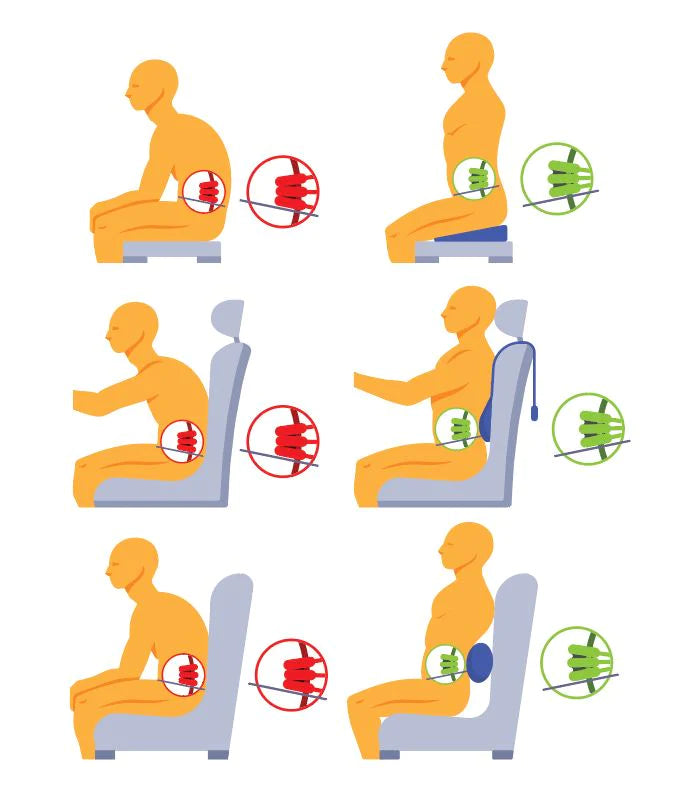
The use of a posture-correcting cushion
At first, we sit with a straight back on an average chair, but since this requires significant muscle effort, our body adopts a slouched posture by taking the easier path. Of course, this happens unconsciously, independent of our will. Since slouching negatively affects our spine due to the increased pressure on our lumbar discs, we must consciously fight against it.
Using a posture-correcting cushion proves to be very effective in this regard. There are cushions that need to be placed on the seat surface of our chair, while others should be placed behind our lower back, but the goal is the same in all cases: to maintain the anatomical curvature (lordosis) of the spine.
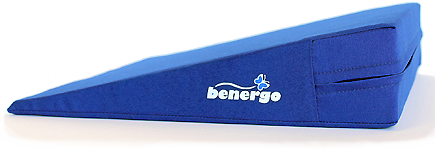
Posture-correcting seat cushion | benergo wedge cushion
The most widely usable posture-correcting seat cushion is the wedge cushion. It can be used in almost any average sitting position to correct a slouched sitting posture:
- in an office environment,
- at the dining table,
- while sitting at the home desk,
- or even in a parked car seat.
Its function is based on the simple principle that sitting on its sloped shape causes our pelvis to tilt forward, and as a result, we involuntarily straighten our upper body, "pulling ourselves up". Thus, with this posture-correcting seat cushion, our posture becomes ideal again, and our intervertebral discs are placed in a protected state.
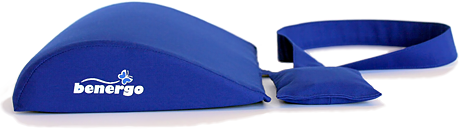
Posture Corrector Cushion | Benergo Lumbar Support
The Benergo lumbar support is a posture-correcting cushion that is also used while sitting on a chair, but it should be placed on the backrest, behind the lower back.
As its name suggests, this cushion supports our lower back, thus preventing the development of a slouched sitting posture. It can also be called a passive cushion, as it does not force the spinal muscles to do any work during use, so the back muscles remain passive in this sitting position. We primarily recommend it for car seats, but many also use this posture-correcting cushion attached to the backrest of a chair.